

Functional Nutrition for Women in Perimenopause and Menopause
Personalized. Virtual. Covered by insurance.

What worked in your 30s just doesn't work anymore.
For years, estrogen quietly supported your metabolism, your muscle, and your blood sugar. As it declines, those systems need a new plan. I use functional testing to find out exactly what's happening in your body, then build nutrition around your results.

Hi, I'm Claire, MS, RD, IFNCP, CMCS
Functional Dietitian and Certified Menopause Coaching Specialist
I became a Registered Dietitian because I believed healthcare could go deeper, beyond 15-minute appointments and symptom management, to the root causes of why people feel the way they do. Functional nutrition was always the goal.
Then I watched my peers, sharp, vibrant women in their 40s and 50s, start struggling in ways they couldn't explain. I added a Certified Menopause Coaching specialty because I saw exactly where functional nutrition could make the biggest difference.
Before opening my private practice full time, I worked as a clinical dietitian in general medicine at UCHealth, one of Colorado's leading hospital systems. That experience deepened my understanding of how metabolic disease, chronic illness, and hormonal changes show up in real patients, and reinforced why a root cause approach matters so much.
Because this care should be accessible to every woman who needs it, I accept most major insurance plans across Arizona, California, Colorado, Connecticut, Massachusetts, Michigan, New Jersey, New York, Texas, and Virginia.
My Specialties
With every patient, I start by thoroughly investigating three areas — chronic inflammation, blood sugar balance, and gut health — using lab work and, when applicable, advanced functional testing. These are deeply connected and addressing them together is often what finally moves the needle when nothing else has.
-
![Minimalist line drawing of a person's shoulder and neck, with a red Wi-Fi signal icon at the back of the neck]()
Chronic Inflammation
Inflammation is like a small fire burning inside your body that you can't see or feel at first — but over time can accelerate many of the symptoms you're experiencing in perimenopause — including joint pain, brain fog, and even frozen shoulder.
The good news? Food, lifestyle, and stress management are powerful tools to put out that fire. Together we'll focus on an anti-inflammatory eating pattern rich in omega-3s and colorful vegetables, and where needed, identify and eliminate food sensitivities that may be quietly fueling the flames.
-
![Line drawing of an amusement park roller coaster with tracks and a lift hill.]()
Blood Sugar Balance
Insulin resistance often gets worse during perimenopause — and it's one of the most overlooked reasons women start gaining weight, feeling exhausted, and experiencing mood swings seemingly out of nowhere.
The good news? It's addressable. Together we'll look at meal timing, building balanced plates with protein, healthy fats, and fiber, and — when needed — run labs like fasting glucose, fasting insulin, and HbA1c to see exactly what's going on beneath the surface.
-
![Line drawing of a person with curly hair, with a pink concentric circle pattern on their chest, representing meditation or focus.]()
Gut Health
Your gut health directly influences how you experience menopause. A healthy microbiome helps metabolize hormones efficiently, produces mood-regulating neurotransmitters, and keeps inflammation in check — all of which impact your hot flashes, mood, energy, and weight.
When needed, I use the GI-MAP — one of the most comprehensive functional stool tests available — to uncover hidden imbalances in your gut bacteria or underlying inflammation that a standard doctor's visit would never catch. From there, we build a targeted nutrition plan to heal from the inside out.



Professional Grade Supplements
Supplements only work when they're personalized: the right form, the right dose, and the right combination for your biology. That's why I recommend them based on your labs, not trends.
Every product in my dispensary is professional grade and third party tested. I partner with Fullscript, which sources directly from manufacturers, so you avoid the counterfeit and improperly stored products common on big online marketplaces.
No guesswork. No wasted money on supplements that don't move the needle.
I know it’s hard to always focus on meals when life gets busy. That’s why I have created simple meals built on my 30/30 Framework: 30 grams of protein per meal and 30 grams of fiber per day. Designed for real life in perimenopause and menopause.
Every recipe is quick to make, easy to prep ahead, and made with your whole family in mind. No specialty ingredients, no complicated steps.
Good food that actually supports your muscle, blood sugar, gut health and energy.
High Protein, Fiber Rich Recipes
Common Questions
-
Your doctor manages your hormones. I manage everything that influences them. Hormone replacement therapy (HRT) can be a powerful tool, but it was never designed to optimize insulin sensitivity, rebuild muscle mass, resolve gut imbalances, or address the micronutrient deficiencies quietly worsening your symptoms. That's exactly where functional nutrition fills the gap. If you're doing everything right and still not feeling better, nutrition is very likely the missing piece.
-
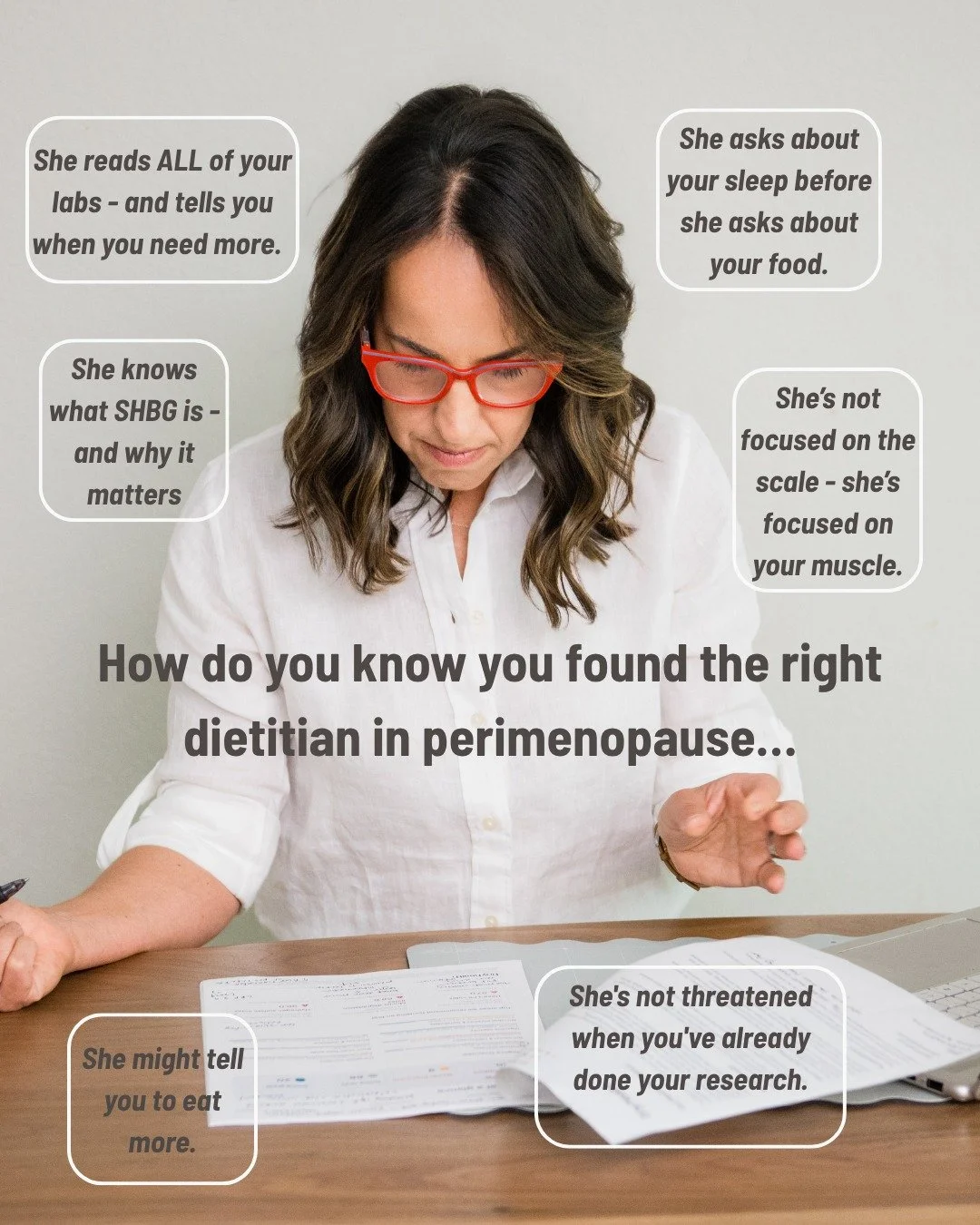
Look for someone with real clinical credentials, not just a certificate from a weekend course. A Registered Dietitian (RD) has completed a supervised practice program and passed a national board exam, which means they're trained to interpret labs, understand drug-nutrient interactions, and work safely alongside your medical care. Beyond that, look for someone who specializes specifically in perimenopause and menopause, not general wellness. Hormonal transitions have their own physiology, and a specialist will know how insulin resistance, gut health, and micronutrient status shift during this time in ways a generalist may not.
-
"Nutritionist" isn't a protected title in most states. Anyone can call themselves one, regardless of training. "Registered Dietitian" (RD) is a legally protected credential that requires a nutrition degree, a supervised practice program, and a national board exam. Registered Dietitians are also the only nutrition professionals recognized to bill insurance directly for medical nutrition therapy. When you're navigating something as complex as hormonal shifts, that clinical training matters — it's the difference between general advice and a plan built around your actual labs and physiology.
-
Your initial session is 90 minutes. Enough time to actually understand your story. We review your health history, symptoms, labs, and goals in depth. No rushing, no shortcuts. By the end you'll have a clear picture of what's driving your symptoms and a plan for what we address together.
-
Most likely, yes. I'm in network with Aetna, Cigna, UnitedHealthcare, and Blue Cross Blue Shield through Berry Street, which verifies your benefits before your first appointment so there are no surprises. Most of my clients pay $0 out of pocket, and many have access to unlimited nutrition visits.
If your plan doesn't cover nutrition counseling, or you'd prefer not to use insurance, I offer straightforward cash rates: $150 for the initial 90-minute visit and $100 per hour for follow up appointments. Functional lab testing is billed separately, and I'll always review the cost with you before ordering anything.
You can book through Berry Street using the "See if you're covered" button, or contact me directly.

Ready to get started?
Here’s what working together looks like:
We begin with a 90-minute initial appointment where we review your health history, current symptoms, and labs in depth. No rushing, no shortcuts. Just real time focused on understanding what's driving how you feel.
From there, follow-up sessions tackle what matters most to you whether its meal planning, body composition goals, functional lab testing like DUTCH hormone panels or GI-MAP stool analysis, and supplement protocols tailored to your specific biology.
95% of clients pay $0 out of pocket.
I've partnered with Berry Street Nutrition to accept most major insurance plans including Aetna, Cigna, UnitedHealthcare, and Blue Cross Blue Shield across Arizona, California, Colorado, Connecticut, Massachusetts, Michigan, New Jersey, New York, Texas, and Virginia.
Berry Street automatically verifies your coverage before your first appointment so there are no surprises.
In fact, many women discover they have access to unlimited nutrition visits with $0 copay.
If your plan doesn't cover nutrition counseling, or you'd prefer not to use insurance, I offer straightforward cash rates: $150 for the initial 90-minute visit and $100 per hour for follow up appointments. Reach out below and we’ll get you scheduled.
Follow along @nutrition_with_you




Questions about insurance, scheduling, or getting started? Message me directly below. I respond usually within 1–2 business days. I look forward to working together.